
Countertop Ice Maker for a Small Office Break Room
Sizing a plumbing free bullet maker for a ten person break room, from daily output to who refills the tank.

Key takeaways
- A ten person office typically needs only two to five pounds of ice a day, so a 26 pound rated bullet maker has plenty of headroom.
- A plumbing free unit around 100 to 150 dollars pays for itself against bagged ice runs in under six months.
- Set the machine on an anti-vibration pad and away from desks so the hum and ice drop do not bother nearby calls.
- A labeled refill pitcher and a whoever-empties-it-refills-it rule keeps the tank from running dry.
- Build maintenance into the week: drain the tank every Friday and descale monthly, more often on hard water.
A friend runs a small design studio, ten people, one break room, one sad little freezer that iced over every August. Every couple of days someone drew the short straw and drove to the gas station for a bag of ice that half melted before it hit the cooler. When she asked me to fix it, the answer was a countertop ice maker for office use, sitting right next to the coffee station.
That was eighteen months ago. The bagged ice runs stopped, the freezer stopped fighting for space, and nobody has cursed at a jammed ice tray since.
Here is how I sized the machine, what it actually delivers for a full workday, and the small logistics that make or break the whole thing.
Working out how much ice ten people actually need
Start with the drinks. In a ten person office, most people are not chugging iced beverages all day. On a normal afternoon you might see five or six iced coffees, a few cans over ice, and someone refilling a water bottle with a scoop.
Call it two to three pounds of ice across a typical day. On a hot Friday with a client visit, maybe five pounds. That is the target range, and it is genuinely modest.
Where people go wrong is chasing the big rated number on the box. A machine that advertises 26 pounds a day sounds like overkill for five pounds of demand, and in a sense it is, but that rating is not the number that matters here.
The 24-hour rating assumes the bin is emptied constantly and the room is cool. In real office use you care about the first hour of output and how fast the bin refills after a lunchtime rush, not the theoretical daily ceiling.
I break down why that headline figure rarely lands in practice over in my piece on how countertop ice maker daily output really adds up. For an office, the honest math is simpler: if the machine makes a pound of ice every 15 to 20 minutes and holds a couple pounds in the bin, ten people will never out-drink it.
The machine I picked and why
I went with a mid-size bullet-ice maker, a Euhomy rated at 26 pounds a day, for about 120 dollars. It sits roughly 12 inches wide and 15 inches tall, which fit the counter gap beside the sink with room to open the lid.
The reasoning was boring on purpose. Bullet makers are cheap, reliable, and plumbing free. You fill a tank, they make ice, and when something goes wrong you are out 120 dollars, not 600.
A nugget machine like the GE Profile Opal makes lovely chewable ice, but at 550 dollars it felt like a lot to hand ten coworkers who might leave the lid open. For a first office machine, I like the low-stakes option.
| Model | Ice type | Rated output | Rough price | Office fit |
|---|---|---|---|---|
| Euhomy / Silonn compact | Bullet | 26 lb/day | $100-130 | Great starter, plumbing free |
| Newair 50 lb unit | Bullet | 50 lb/day | $150-200 | Big office or heavy use |
| Frigidaire EFIC237 | Bullet, dual size | 26 lb/day | $120-150 | Solid, dual cube sizes |
| GE Profile Opal | Nugget | 24 lb/day | $500-600 | Premium, if budget allows |
If you want to weigh the machine against the counter it lives on, my notes on countertop ice maker footprint and weight cover the sizing details before you commit to a spot.
Quiet enough to live near desks
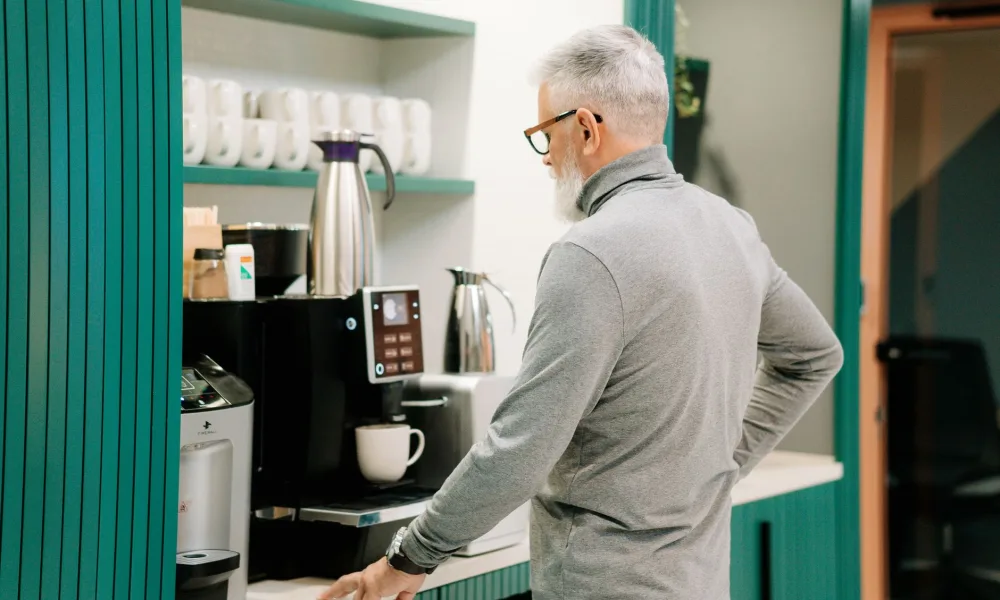
This is the part offices underestimate. Break rooms are often open to the desks, and a machine that clatters every 15 minutes gets old fast when Sarah is on a client call ten feet away.
Bullet makers make noise in two moments: the pump humming while it runs, and the clatter when finished ice drops into the bin. The hum sits around 40 to 45 decibels, roughly a quiet fridge. The ice drop is a brief rattle, louder but short.
My fix was placement. I set the machine on a rubber mat and pushed the whole coffee station a few feet from the nearest desk. That took the edge off the drop noise, which travels through hard counters.
A cheap silicone trivet or anti-vibration pad under the machine kills most of the resonance you hear through a countertop. It is the single best five dollar upgrade for an office unit.
If noise is your top worry, it is worth shopping specifically for it. I round up the calmer options in my guide to the quietest countertop ice makers for small spaces, and the same picks that suit a small apartment tend to suit a break room.
Who refills the tank, and how you keep it fair
Every office ice maker dies the same death: nobody wants to be the tank person. The reservoir on my Euhomy holds about 2 liters, and in steady office use that is a refill roughly every two to three hours.
I solved it with a pitcher and a rule. A clearly labeled 2 liter pitcher lives next to the machine, and the deal is whoever empties it refills it, same as a coffee pot.
That simple norm did more than any feature on the machine. Topping off from a pitcher is a five second job, so it never feels like a chore, and the machine rarely runs dry.
The most common office mistake is letting the machine drain fully before anyone refills. A dry machine has to chill a fresh tank from scratch, so you lose 15 minutes of output right when the afternoon crowd wants ice. Top off at the quarter mark instead of waiting for the add-water light.
The tank rhythm is the same whether the machine is in a kitchen or a cubicle farm, and I go deeper on it in my breakdown of countertop ice maker tank capacity and refills.
Why a portable unit beats the bagged ice run
Let me put real numbers on it. The studio was buying two 10 pound bags a week at about 3 dollars each, so roughly 6 dollars a week, plus someone’s 20 minute round trip.
The machine cost 120 dollars up front and draws around 120 watts while running, which over a workday lands near 10 to 15 cents of electricity. Add a little water and the odd descaling. Running cost is a few dollars a month.
So the machine paid for itself against bag purchases in under half a year, and that ignores the real cost, which was the errand. Nobody bills their afternoon to fetching ice.
- No more melted bags sloshing in the trunk
- Fresh ice on demand, not whatever survived the drive
- No freezer space lost to leaking bags
- One less recurring errand on someone’s plate
The bag of ice was never really about the ice. It was about someone giving up twenty minutes of their day, twice a week, for the privilege.
There is also the freezer to consider. Reclaiming that shelf meant the office fridge finally had room for lunches, and the ancient ice trays went in the recycling for good.
The upkeep that keeps an office machine alive
A machine ten people share gets neglected, so I built maintenance into the routine rather than hoping someone volunteers. The two jobs that matter are emptying it and descaling it.
At the end of each week, whoever locks up drains the tank through the bottom plug and leaves the lid open overnight. Standing water in a warm break room over a weekend is how you get film and a musty smell by Monday.
Once a month, the machine gets a descale cycle with a vinegar and water mix to clear mineral scale off the freezing pins. If your building is on hard water, that scale builds faster. The U.S. Geological Survey explainer on water hardness shows where your area lands, and if you are in a hard-water zone my notes on countertop ice maker upkeep in hard water areas cover a tighter schedule.
To understand why these plumbing free machines need that recirculation cleaning at all, my primer on how countertop ice makers work walks through the closed loop that reuses the same water until you empty it.
Making the call for your own break room
For a ten person office, a plumbing free bullet maker in the 100 to 150 dollar range is almost always the right answer. It out-produces the demand, it lives quietly beside the coffee, and it kills the bagged ice errand within a few months.
The machine is the easy part. The habits are what keep it going: a labeled refill pitcher, a Friday drain, a monthly descale, and an anti-vibration pad so nobody on a call wants to unplug it.
Get those small things right and the whole break room forgets the machine is even there, which, for an appliance ten people share, is exactly the goal.
Frequently asked questions
For roughly ten people, a standard countertop bullet maker rated at 26 pounds a day is more than enough. Real office demand is usually two to five pounds across a full day. You care more about how fast the bin refills after a lunch rush than about the headline daily rating.
Most bullet makers hum at around 40 to 45 decibels, similar to a quiet fridge, with a brief rattle when finished ice drops into the bin. That is fine for a break room but can carry to nearby desks. Placing the machine on a rubber pad and a few feet from workstations takes the edge off.
The simplest system is a shared norm, the same one that works for a coffee pot. Keep a labeled pitcher next to the machine and make the rule that whoever empties the tank refills it. Topping off takes about five seconds, so it rarely feels like a real chore.
No. Countertop units are plumbing free, which is the whole appeal for an office. You fill a tank by hand and the machine recirculates its own meltwater, so there is no line to install and no drain to connect. You just empty the tank manually when you clean it.
A typical machine draws around 120 watts while running, which works out to only a few dollars a month in electricity for a normal workday. Add a little water and monthly descaling and the running cost stays low. Against two bags of store ice a week, the machine usually pays for itself within six months.
Drain the tank at the end of each week and leave the lid open so it dries out, which prevents film and odors over the weekend. Run a vinegar and water descale cycle about once a month to clear mineral scale off the freezing parts. On hard water, descale more often.

About the Author
Madhu Malhotra
Madhu Malhotra reviews nugget ice makers, countertop units, and portable freezers with a focus on real world durability. Over more than ten years of testing home ice machines she has learned which build details actually hold up, how to keep water lines clean without harsh chemicals, and what the marketing brochures quietly leave out. Her write ups aim to save readers a return trip and a wasted weekend.
Related guides

Why Your First Portable Ice Maker Batch Tastes Off
Your new machine works fine. The plasticky first batch is factory residue, and a couple of throwaway cycles fixes it.
Running a Portable Ice Maker Off a Battery Bank
How to run a portable ice maker off a power station without tripping it, plus the watt-hour math that stretches a charge on a camping weekend.

Fixing a Plastic Taste From Countertop Ice Makers
A room by room fix for lingering plastic taste, from vinegar flush cycles to airing the reservoir, so your bullet ice finally tastes like nothing.