
Handling Hard Water Scale in an Ice Maker
How calcium and magnesium crust up your reservoir and evaporator, why it clouds and slows your ice, and how a hardness test sets your descale rhythm.
Key takeaways
- Hard water scale is calcium and magnesium left behind as ice freezes, drying into a chalky crust in the reservoir, pump, and evaporator.
- Scale on the freeze plate insulates the metal, which is what makes ice cloudy and stretches batch times by several minutes.
- Test your water hardness with a strip kit or your utility report, then match that number to a descaling frequency.
- Soap and a rag remove slime but not scale; only an acid like vinegar or citric acid dissolves mineral buildup.
- Filling with filtered or blended low-mineral water slows how fast the crust returns between descales.
The first time I pulled the reservoir out of my Frigidaire EFIC237 after a few months of daily use, I found a ring of white crust around the fill line that felt like fine sandpaper. That crust is hard water scale in an ice maker, and it had already started to slow my batches down without me noticing.
Most people blame the machine when ice gets cloudy or the cycles drag. Usually the machine is fine. The minerals in your tap water are the real culprit, and once you understand how they behave, the fix becomes obvious.
I have opened up more of these machines than I care to admit, from countertop nugget makers to the little bullet-ice units, and the scale story is always the same. Here is what is actually happening inside.
What hard water scale actually is
Hard water is water carrying dissolved minerals, mostly calcium and magnesium. The USGS explains it plainly on its water hardness science page: the more calcium and magnesium your water holds, the harder it is.
When that water sits in a warm reservoir and then freezes and thaws through cycle after cycle, the water leaves but the minerals stay behind. They dry into a chalky white film. That film is calcium carbonate, the same stuff that fogs up a shower door or crusts a kettle.
In an ice maker the scale does not stay in one spot. It coats the reservoir walls, works into the pump, and settles on the evaporator where the ice actually forms. Each surface it touches causes a different problem.
Why your ice turns cloudy and your batches slow down
Cloudy ice is the first sign most people notice. When water carries a heavy mineral load, those minerals get trapped inside the ice as it freezes fast, and the cubes come out white or milky instead of clear.
A GE Profile Opal makes nugget ice that is naturally a little opaque, so scale there shows up more as a chalky taste and a slower fill. On a clear-cube maker like a Newair or an Euhomy, cloudy ice is a loud signal that minerals are building up.
The slowdown is the part that costs you. Scale on the evaporator plate acts like a blanket. The metal has to pull heat through a mineral crust before it can freeze the next batch, so a cycle that used to run 8 to 12 minutes stretches to 15 or more.
I timed this on a Silonn bullet maker once. Fresh out of the box it turned out a batch every 9 minutes. After two months on hard tap water with no cleaning, the same batch took 14. That is roughly a third less ice per day from the exact same machine.
A machine rated for 26 pounds of ice per day is measured with clean water and a clean plate. Heavy scale can quietly knock that down to 18 or 19 pounds without a single error code showing up.
Where the scale hides inside the machine
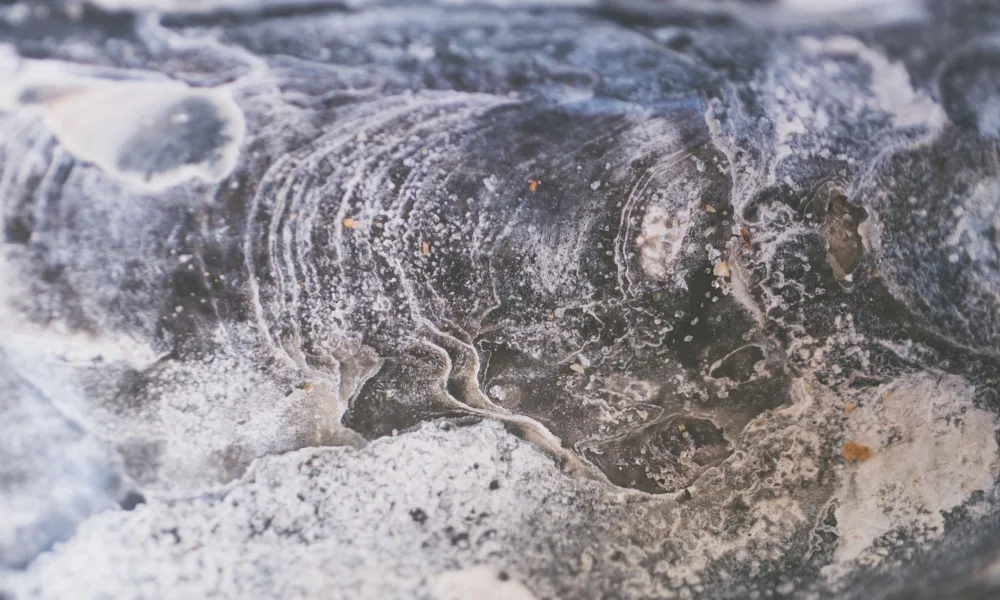
Three spots do most of the damage, and each one behaves differently.
- The reservoir: the easiest to see and the easiest to wipe. Scale here is cosmetic at first but sheds flakes into the water that circulate everywhere else.
- The pump and water lines: the hidden problem. Mineral buildup narrows the tubing and makes the pump work harder, which is often why an older unit gets loud.
- The evaporator or freeze plate: the expensive spot. This is where scale slows freezing and dulls ice clarity the most.
Because scale travels from the reservoir into the pump and onto the plate, wiping only the tank you can see leaves most of the problem in place. A proper descale has to run cleaner through the whole water path, which is exactly why the full step-by-step cleaning routine pushes solution through a complete cycle rather than just a wipe-down.
How to know how hard your water actually is
You cannot set a smart cleaning schedule until you know what you are dealing with. Water hardness is measured in grains per gallon (gpg) or parts per million (ppm), and the two convert cleanly: 1 gpg is about 17.1 ppm.
| Hardness level | Grains per gallon | What it means for your ice maker |
|---|---|---|
| Soft | 0 to 3 gpg | Minimal scale, longest gaps between descales |
| Moderately hard | 3.5 to 7 gpg | Visible film in a month or two |
| Hard | 7 to 10.5 gpg | Noticeable slowdown, monthly descale territory |
| Very hard | Over 10.5 gpg | Fast crusting, descale every 2 to 3 weeks |
The cheapest way to test is a paper strip kit, usually 8 to 12 dollars for a bottle of 100. You dip one strip, wait a few seconds, and match the color. Many city water utilities also publish an annual report with your exact hardness number, so a quick search of your utility name plus water quality report often saves you the strip.
Test the water you actually pour into the machine, not just the kitchen tap. If you fill from a fridge dispenser or a pitcher filter, test there. A carbon pitcher filter improves taste but does almost nothing for hardness, so do not assume filtered means soft.
Turning your hardness number into a cleaning rhythm
Once you know your number, the descaling frequency almost picks itself. Soft-water households can stretch to every 6 to 8 weeks. Hard-water homes need a descale every 3 to 4 weeks, and very hard water pushes that to every couple of weeks.
The signal I trust more than any calendar is batch time. When your cycles start running noticeably longer than they did new, scale is the first thing to rule out. That single observation ties into the broader weekly to yearly cleaning schedule so you are not guessing.
For the actual descale, most people reach for one of two options. A diluted white vinegar solution works and costs almost nothing, which is why the vinegar descaling walkthrough is a reader favorite. Commercial descalers are formulated to hit mineral scale harder and rinse cleaner, and the trade-offs between the two get compared side by side if you are trying to decide.
Scale is not a cleaning failure. It is just chemistry doing what chemistry does, and it responds to a schedule better than it responds to scrubbing.
The mistake that lets scale win
The most common mistake I see is treating scale like a slime problem. People wipe the reservoir with a soapy cloth, see it look clean, and call it done.
Soap and a rag remove biofilm and pink or black gunk beautifully, but they do not dissolve calcium carbonate. Mineral scale needs an acid, either the acetic acid in vinegar or the citric acid in a commercial cleaner, to break the bond and lift off the surface.
So a machine can look spotless and still be crusted with invisible scale on the evaporator. If your ice is cloudy and slow after a normal wipe-down, that is your tell. A dedicated descale, not a scrub, is what the machine is asking for, and a badly neglected unit may need the longer deep-cleaning treatment before it behaves again.
Cutting the scale off before it starts
You can slow scale dramatically by feeding the machine better water. This is the part most owners skip.
Using filtered or low-mineral water in the reservoir means fewer minerals go in, so less scale comes out. I am not talking about a fancy setup: a basic pitcher of filtered water plus, in very hard areas, a bottle or two of distilled mixed in makes a real difference in how fast the crust returns.
Do not run pure distilled or fully deionized water long-term in a machine with a water-level sensor. Some units read water by its conductivity, and mineral-free water can confuse the sensor into thinking the tank is empty. A blend of filtered and distilled is the safe middle ground.
Empty the reservoir when the machine sits unused, too. Standing hard water evaporates and concentrates its minerals, so a tank left full over a long weekend crusts faster than one you drain.
Making the call on your own machine
Scale is predictable, which is the good news. Test your water once, match that number to a descaling rhythm, and the cloudy ice and dragging cycles mostly disappear.
If your ice looks milky and your batches feel slow, do not run out and buy a new unit. Nine times out of ten it is a mineral crust, not a dead machine, and an acid descale plus slightly better water brings it right back. Learn your hardness number this week, and let it set the schedule for you.
Frequently asked questions
Occasional scale does not cause permanent damage, but long-term neglect can. A thick crust makes the pump work harder and the compressor run longer, which shortens the life of both. Regular descaling keeps the machine within its normal working range.
A standard carbon or pitcher filter improves taste and removes chlorine but does very little for hardness. Calcium and magnesium pass right through most basic filters. Only a softener, a reverse osmosis system, or blending in distilled water actually lowers the mineral load.
Yes, cloudy ice from dissolved minerals is safe to consume. The cloudiness is trapped calcium and magnesium plus tiny air bubbles, not contamination. It may taste slightly chalky, but it will not make you sick.
With very hard water above 10.5 grains per gallon, plan to descale every 2 to 3 weeks. Watch your batch times as a live signal too. When cycles run noticeably longer than when the machine was new, it is time for a descale regardless of the calendar.
You can use it most of the time, but avoid running pure distilled water long-term in machines that sense water by conductivity. Mineral-free water can trick the sensor into reading the tank as empty. A blend of filtered and distilled water avoids the scale without confusing the machine.
Scale narrows the water lines and coats the pump, so the pump strains against restricted flow and gets noisier. A full descale that runs cleaner through the whole water path usually quiets it back down. If noise persists after descaling, the pump itself may be wearing out.

About the Author
Madhu Malhotra
Madhu Malhotra reviews nugget ice makers, countertop units, and portable freezers with a focus on real world durability. Over more than ten years of testing home ice machines she has learned which build details actually hold up, how to keep water lines clean without harsh chemicals, and what the marketing brochures quietly leave out. Her write ups aim to save readers a return trip and a wasted weekend.
Related guides
How to Clean an Ice Maker Water Sensor
The little sensor that tells your machine how much water is in the tank gets fooled by scale and film, and a two-minute swab fixes it.
How to Drain an Ice Maker Completely
The plug is only half the job. Here is how to pull the last cup of water out of the reservoir and pump so your unit stores dry.
Prevent Mold and Smell in Your Ice Maker
The habits that keep an ice maker fresh cost you about two minutes a day and save you from ever scrubbing pink slime out of a tank again.